Module 1 · Lesson 2 · 9 min read
Core Practices
These are the practices this course uses, step by step, so every money lesson can point you here instead of repeating them.
Money decisions are made by a nervous system. When that system is tight, scattered or frightened, you buy, borrow and sign from fear. When it is calm and present, you see clearly. Every practice below is one I use myself or teach in sessions, in a safe starting dose.
Lesson overview
This section contains a general overview of topics that you will learn in this lesson.
- Three breathing practices that calm you before any money decision.
- Grounding practices for nature and the body.
- Practices for attention and presence, the real currency of wealth.
- Paper practices that make your money visible.
- Which practice to use in which situation.
The core teaching
Money follows attention, and attention follows the state of your body. So before you change your money, change your state: empty the breath, come down into the body, become present, and then put the numbers on paper. A calm body reads a deal, a debt or a purchase far more truly than a panicking mind.
Kund Breathing (belly breathing lying down)
Kund Breathing is my main recovery practice. “Kund” points to the belly, the seat of your energy. Prana, the life force carried by the breath, settles there when the breath is slow and low.
- Lie on your back on a mat or bed. Let your arms rest by your sides.
- Place your attention on your belly, not on your thoughts.
- Let the belly rise as you breathe in and fall as you breathe out. Do not push. Simply keep watching the movement.
- When the mind wanders, bring it back to the belly without judging yourself.
Start with 10 to 15 minutes once or twice a day. In a hard phase you can do it more often. It is the practice I give first to someone in financial panic, because it slows the whole system down.
Slow mouth exhalation
This practice empties stale air and stale tension. Sit or stand comfortably.
- Breathe in through the nose.
- Release the breath through the mouth slowly, as if your life is moving in slow motion.
- Count silently while you exhale, until the belly is gently empty. You can add a soft “ha” sound.
- Let the next breath come in by itself.
Do 8 to 12 rounds. Stop if you feel dizzy, and never force the last bit of air out.
Walking exhalation
I teach this one while walking, especially when I move from a polluted city into green air. Whenever you walk in nature, make each exhalation complete.
- Walk at an easy pace.
- Breathe out slowly through the mouth, emptying the belly as if in slow motion.
- Do not pull the next breath in. Let the inhalation happen on its own.
- By the third exhalation you will notice the inhalation becomes deeper and easier.
Start with about ten exhalations. When it is comfortable, you can build up to 21 slow rounds on a walk. If you feel light-headed, return to normal breathing.
The breath hold after exhaling (external Kumbhak)
Kumbhak means holding the breath. External Kumbhak is a short pause with the lungs empty. It brings a moment of stillness, which is exactly what you need before a decision.
- Sit upright. Breathe in gently, then breathe out fully but softly.
- With the lungs empty, pause for 3 to 5 seconds, or as long as is comfortable.
- Let the breath return by itself. Rest for a few normal breaths.
Do about three rounds. Never hold until you feel breathless or strained; longer holds are learned only with guidance. The Yoga and Breathwork course explains this hold in more depth.
Malasana, the grounding squat
When your energy is stuck in the head, money worries spin endlessly. Malasana brings it down. It is a deep squat with the feet on the ground and the hips low.
- Stand with your feet a little wider than your hips, toes turned slightly out.
- Lower your hips towards the ground. Bring your palms together at the chest, elbows resting inside the knees.
- Breathe slowly into the belly and feel the stretch in the pelvis and legs.
Start with one to two minutes and build up towards ten to fifteen minutes over weeks. On the ground in nature, and barefoot where the ground is safe, the grounding is deeper. If your knees or ankles hurt, sit on a low block or skip it.
Touching nature
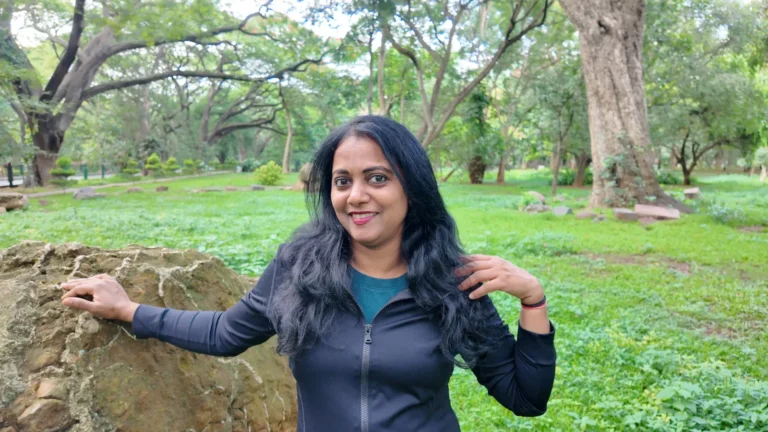
When you are in nature, don’t only look at it. Touch it. Hold a tree trunk and feel its texture. Feel a rock under your palm. Use a stick on a steep path. Each surface has its own field, and touching it brings your attention out of the mind and into the body. On climbs, lean slightly forward, use your hands where you need them and never take a risky step to prove anything.
Witnessing: doing nothing with full attention
Attention is your real currency. This practice teaches you to keep it with yourself.
- Sit silently for 10 minutes. Do nothing.
- Watch your thoughts come and go, like guests in a hotel. You are the host who stays.
- Notice sensations and emotions in the body. Let them arise and pass.
- When you drift, rest your attention on the breath for a few moments.
The conscious sip
This tiny practice teaches the difference between price and value. You paid a price for your water or meal. The value depends on whether you are present.
- Take one sip of water. Taste it. Move it around your mouth and feel it. Don’t swallow mechanically.
- When you eat, chew each mouthful until it becomes a paste.
My short formula is: drink your food and chew your water.
The expansion check before a money decision
Your Inner GPS, the inner guidance of your own consciousness, speaks through the body. Expansion feels light, open and free. Contraction feels heavy, tight and small.
- Do three slow mouth exhalations and one short external hold.
- Picture the deal, purchase or loan clearly, as if it has already happened.
- Notice the body: do you open or close? Does the chest feel lighter or heavier?
- Write down what you felt before you look at anyone’s opinion.
Use this alongside the numbers, never instead of them. For loans, contracts and investments, also read the terms and take advice from a qualified professional.
Putting the numbers on paper
Fear lives in the blur. When money feels frightening, write every number down in one place: income, rent, school fees, loans, cards, subscriptions and daily spending. Write what you owe, to whom, and what each payment is. When your brain sees the whole picture, it stops imagining that there is no way out and starts looking for one.
The evening energy ledger
Spend ten minutes in silence at the end of the day and ask two questions. Where did I invest my energy today? Did it make me grow, or did it deplete me? Write one line for each. Over a month this ledger shows you where your time, money and attention really go.
Gratitude when money arrives
Each time money comes into your life, pause and feel it in the body. Thank the work, the people and the exchange behind it. This dissolves the old belief that money is dirty or unspiritual, and it trains you to receive rather than to grab.
A story from my own day
I recorded one teaching in a forest area near Kathmandu, with a busy road behind me. Out on the city streets I had started to feel claustrophobic because of the poor air. In the trees I began the walking exhalation: one slow, complete breath out, then another, then a third. By the third, the inhalation came deeper on its own, and I felt better and better as I walked. Nothing about my bank balance had changed. My state had. And every money decision I make starts from that state, not from the claustrophobic one.
Recognise your own money situation here? Talk it through with Sanju in a one-to-one session.
Book a session with SanjuWhich practice when
| Situation | Practice |
|---|---|
| Panic about money or debt | Kund Breathing, then slow mouth exhalation |
| Before signing, buying or borrowing | Expansion check with one external hold |
| Mind racing with money worries | Malasana, walking exhalation |
| Money feels like a blur | Putting the numbers on paper |
| Scattered, distracted, spending on impulse | Witnessing, evening energy ledger |
| Spending without enjoying anything | The conscious sip |
| Guilt or resentment around money | Gratitude when money arrives |
| Living in a polluted city | Walking exhalation and touching nature on green walks |
When to seek medical or professional help
- Skip breath holds and forceful exhalations if you are pregnant or have heart, blood-pressure, lung or seizure conditions, unless your doctor agrees.
- Stop any practice if you feel dizzy, faint, numb or in pain.
- For debt, loans, investments and contracts, speak to a qualified financial advisor, a debt-advice service or a lawyer. These practices calm you; they don’t replace advice.
- If money stress brings thoughts of ending your life, contact local emergency services or a crisis line now.
- If symptoms persist or worry you, see a doctor.
Self-check
- Which money situation in your life most needs a calmer state before you act?
- Have you ever made a money decision from contraction and regretted it?
- Where would your evening energy ledger say your attention went today?
Knowledge check
These questions help you check your understanding of this lesson. If you can’t answer one, select it to go back to the part of the lesson that answers it.
Additional resources
This section contains helpful links to related content. It isn’t required, so consider it supplemental.
Lesson complete. Want help applying it to your own life?
Book a session with Sanju
Guru Sanju14 years guiding people through Kundalini awakening, with students in 50+ countries. I help you understand what is happening to you and turn it into growth.
Kundalini and Money · Course menu
Kundalini and Money