Module 5 · Lesson 6 · 7 min read
Why the Himalayas
Introduction
I take students to the Himalayas because the mountains combine everything Kundalini needs: rich prana, clean air, silence, challenge and real physical experience. In this lesson I explain why the Himalayas accelerate awakening in my experience, what happens to the energy there, how to trek with awareness and breath, and how to prepare and stay safe.
Lesson overview
This section contains a general overview of topics that you will learn in this lesson.
- Why the Himalayas are a powerful place for Kundalini.
- Why city life slows Kundalini down.
- How to trek with awareness and a breath that conserves energy.
- What happens to the energy at height, and the difference between oxygen and prana.
- How to prepare, and when you don’t need the mountains at all.
The core teaching
Kundalini evolves through direct experience, not theory. The Himalayas give it rich prana from forests and clean air, negative ions from rivers and waterfalls, deep silence, and a terrain that demands full presence. On a mountain trail the mind can’t wander far, so the body wakes up and the energy integrates. But the mountains are a catalyst, not a requirement. What matters is the daily grounding you carry everywhere.
Why do the Himalayas accelerate Kundalini awakening?
For me, the Himalayas are a living energy field, one of the largest energy vortexes on earth. An energy vortex, in my teaching, is a place where natural energy is concentrated. Several things come together there:
- Prana. Dense forests, mosses and vegetation fill the air with life energy.
- Negative ions. Rivers, waterfalls and mountain air are rich in the charged particles I explain in the negative ions lesson.
- Silence. No traffic, no constant noise. The mind finally gets quiet.
- Challenge. Steep paths, cold and height wake up the oldest, most instinctive part of the brain.
- Space and solitude. Open sky and distance from crowds let the energy expand.
Sages have chosen these mountains for meditation for thousands of years. In my experience, Kundalini receives the fuel it needs there and moves more freely. I sometimes feel strong jerks and movements of energy on the trail, which in my understanding is Kundalini taking in that prana and rising.
Why does city life slow Kundalini down?
In cities, the air is dense, the noise never stops and crowds pull at your attention all day. Most of us sit indoors, protected from uncertainty and disconnected from our bodies. Kundalini, the life energy rising through the spine, has little prana to feed on and little space to move in. That is why so many people’s awakening stalls in the head. The mountains reverse all of this at once.
How do you trek with awareness?
- Wear proper shoes. Trekking shoes with good grip are essential.
- Soften the knees. On steep descents keep your knees slightly bent, never locked, and let your body lean naturally into the slope.
- One step at a time. The mountain rewards patience and punishes haste.
- Feel the ground. Notice rocks, soil, roots and the texture of the path. Every step becomes meditation.
- Breathe out continuously. On hard sections, keep a gentle, steady mouth exhalation as you walk. Many people tire not because the mountain is hard, but because they fight it with a tense body and a held breath. A rhythmic breath conserves energy.
- Climb with joy. There is no competition. Smile, stop to look, and let the climb be play.
Is oxygen the same as prana?
No. Oxygen is a gas; prana is life energy. They often go together, but not always. As you climb higher, oxygen in the air drops. Yet in the forest zones of the Himalayas, prana can be very high because of the abundance of trees and water. And a city room can have enough oxygen but feel almost empty of prana.
This is why I value the rainforest and forest zones on the way up as much as the high peaks. They feed Kundalini richly while the body adjusts. Learn to notice how your body responds to each zone, rather than assuming higher is always better.
How do you prepare for Himalayan trekking?
The full training plan is in Training the Body for the Himalayas. In short: walk daily, climb stairs up and down, take local hikes, cook your own food, and keep a steady breath practice. In the weeks before, make sure your sleep is stable and your energy is grounded. The mountains amplify whatever you bring.
Some people use traditional kitchen remedies such as garlic and ginger soup to support immunity before a trek. If you’d like to try them, ask your doctor first, especially if you take blood-thinning or blood-pressure medicines, because garlic can interact with them. They don’t prevent altitude sickness.
What if you can’t go to the Himalayas?
Most people can’t, at least not yet, and that’s fine. The Himalayas are a catalyst, not a requirement. You can bring their elements into your life wherever you are: forests and parks for prana, rivers, rain and the sea for negative ions, early mornings for silence, hills and stairs for challenge, and walking with breath for presence. The forests lesson shows how.
From my own practice
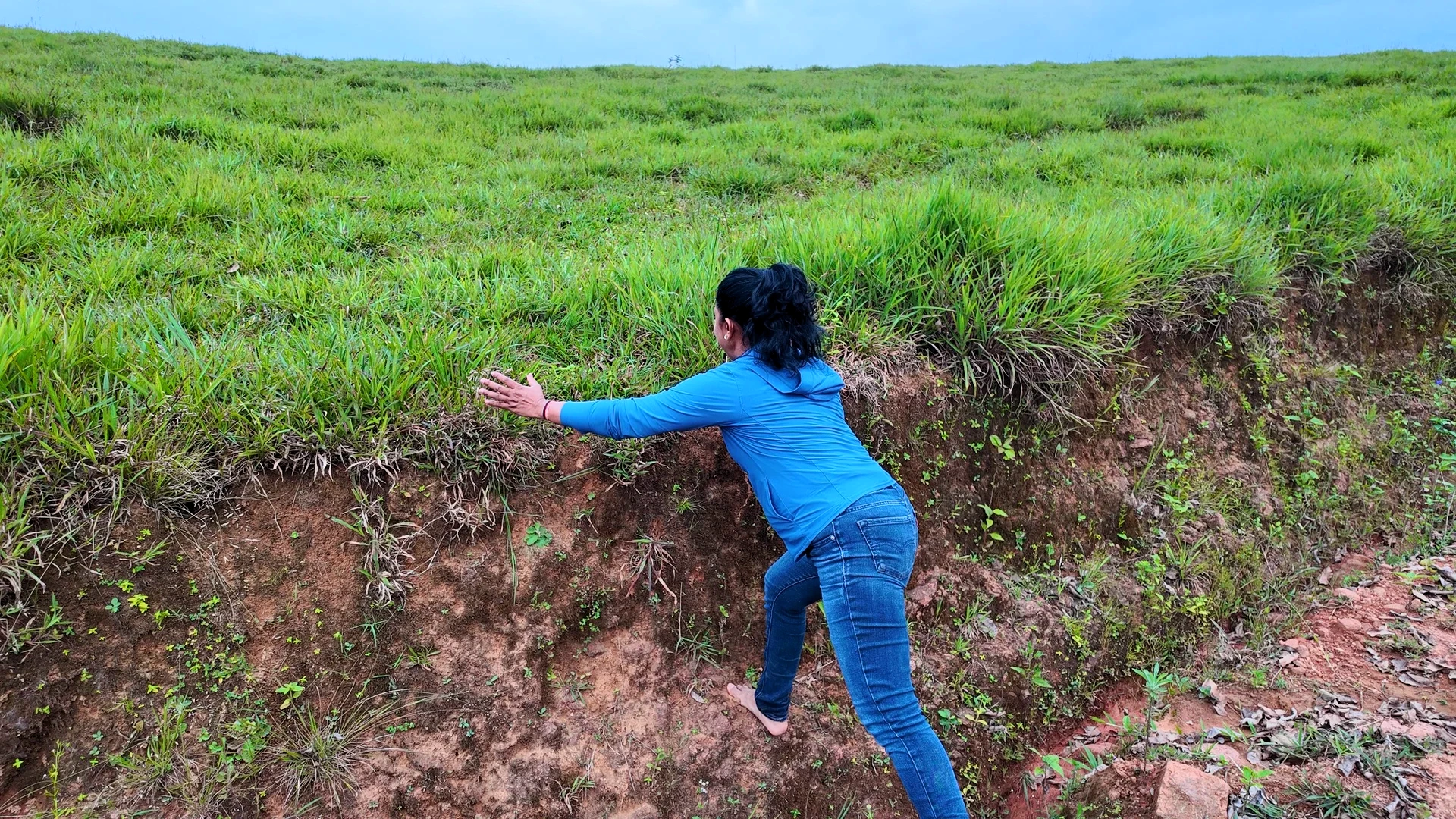
One day I was trekking near Pokhara, in a village area called Methlang. The air quality was extraordinary, with the air-quality index below fifty, and the hills were full of greenery and sunlight. As I descended a steep slope, I noticed how instantly the body becomes present on difficult ground. The mind couldn’t wander far. My senses sharpened and my instincts woke up.
I kept my knees soft, moved one step at a time, and breathed out steadily through the mouth on the hardest parts. The trek became smoother, and I didn’t feel the usual fatigue. A smile came on its own, not because I tried, but because the body was fully alive in the moment. That is the state I want my students to taste, in the mountains and then in daily life.
Finding it hard to ground on your own? Sanju can guide your grounding in a one-to-one session.
Book a session with SanjuBringing the mountains into your month
This month
Mountain qualities at home
- One hill or forest hike each week, with mouth exhalation on the climbs.
- Early mornings outdoors for silence and fresh air.
- Stairs instead of lifts.
- One visit to moving water: a river, waterfall or the sea.
- If a mountain trip is possible, start the twelve-week training plan.
When to get help
High mountains are beautiful and demanding. Respect them.
When to seek medical or professional help
See a doctor before trekking at altitude, especially if you have heart, lung or blood-pressure conditions, are pregnant, or take regular medication. Ascend gradually and learn the signs of altitude sickness: headache, nausea, dizziness, breathlessness at rest, unusual tiredness and confusion. If they appear, stop climbing and descend; severe symptoms are an emergency. Trek with a guide or companion, carry water and warm layers, and don’t practise breath holds at altitude. If you ever feel hopeless or think of harming yourself, contact local emergency services or a crisis line now. See a doctor for any symptom that frightens or worries you.
Self-check
- Which mountain qualities, such as prana, silence, challenge or space, are missing from your daily life?
- How do you breathe when a walk gets hard: held, or flowing?
- Is your body ready for a mountain journey today? What would it need?
Knowledge check
These questions help you check your understanding of this lesson. If you can’t answer one, select it to go back to the part of the lesson that answers it.
Additional resources
This section contains helpful links to related content. It isn’t required, so consider it supplemental.
Lesson complete. Want help applying it to your own life?
Book a session with Sanju
Guru Sanju14 years guiding people through Kundalini awakening, with students in 50+ countries. I help you understand what is happening to you and turn it into growth.
Kundalini Grounding and Integration · Course menu
Kundalini Grounding and Integration