The Core Teaching
A mountain trail makes awareness practical: notice the surface, place the next foot carefully, adapt your balance, and give the terrain your attention. I use trekking to show how learning develops through repeated experience, patience, and preparation. The point reaches beyond the destination. Let an unfamiliar challenge reveal how you respond, where you tense, and what you still need to learn. In my Kundalini teaching, this direct involvement in life gives spiritual understanding a bodily and everyday expression.
Part of my Kundalini Grounding and Integration guide · Teachings by Guru Sanju
Kundalini Thrives Through Real Experience
Kundalini and Himalayan trekking are deeply connected. If you are serious about your kundalini journey, you must understand that evolution happens through direct experience. The life force within you is not interested in theories alone. It responds to reality, movement, challenge, and participation.
Today I am in the Himalayan region near Pokhara, in a place called Methlang. The air quality here is extraordinary. The AQI is below 50, and the environment is filled with freshness, greenery, sunlight, and vitality. This is the kind of environment where the body naturally relaxes, the mind becomes clearer, and the life force feels supported.
Many people approach spirituality as a purely mental process. They read books, collect information, and accumulate concepts. But your brain evolves through experience. Your nervous system evolves through experience. Kundalini evolves through experience.
That is why the mountains have become one of my greatest teachers.
The Mountains Teach What Books Cannot
Every mountain teaches humility. Every trail teaches awareness. Every step reminds you that life demands your full attention.
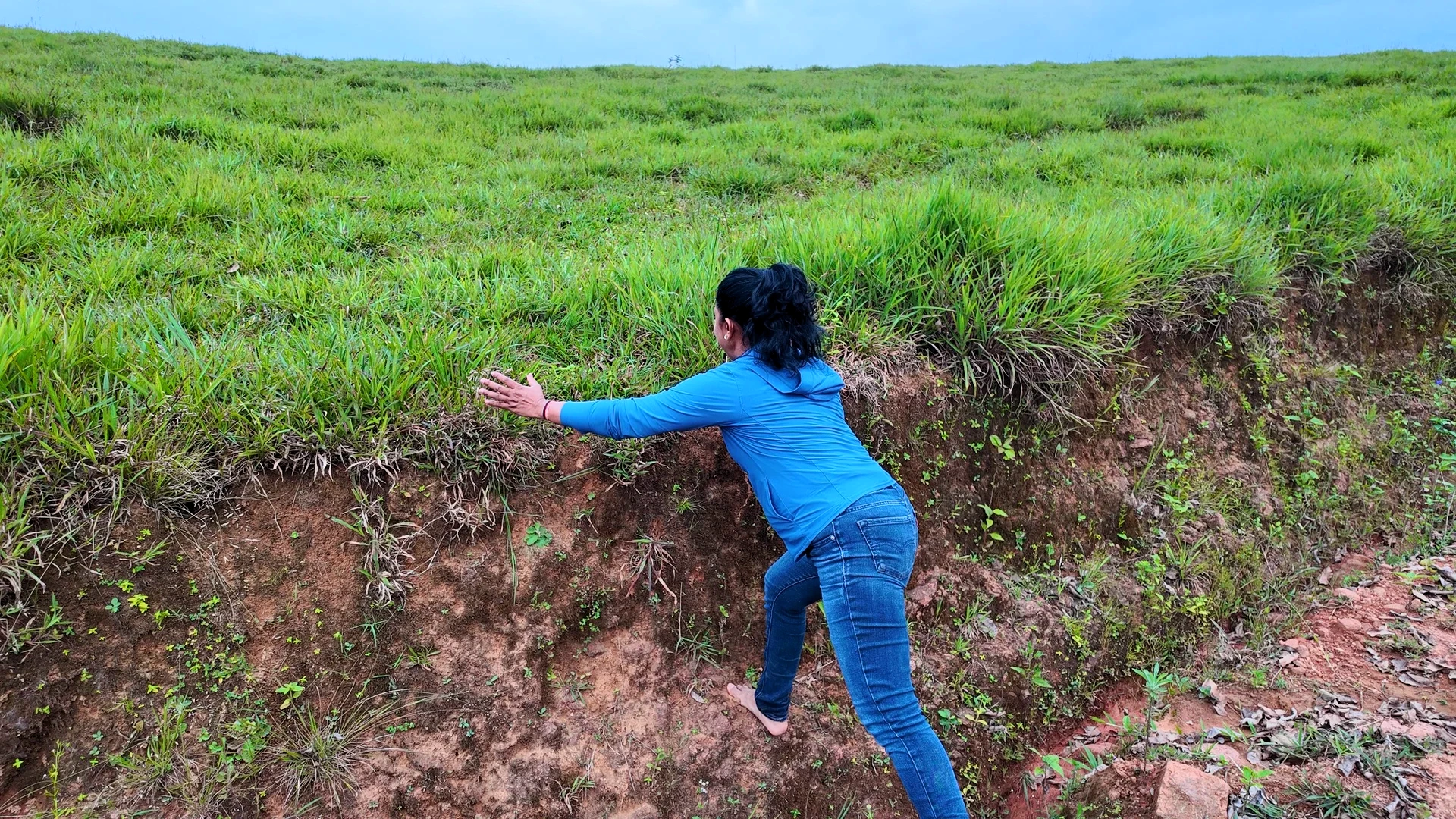
As I descended a steep Himalayan slope, I was reminded that the body instantly becomes present when it enters challenging terrain. The mind cannot wander too far. The nervous system becomes alert. The senses become sharper. Instincts awaken.
This is one of the reasons trekking is so powerful for personal evolution.
Your primitive brain, the oldest part of your neurological system, becomes active. Modern life often disconnects people from these ancient survival mechanisms. We spend most of our time sitting indoors, protected from uncertainty, disconnected from natural challenges.
When you enter the mountains, your brain remembers something it has known for thousands of years.
It remembers how to adapt.
It remembers how to focus.
It remembers how to survive.
Learning to Move with Awareness
One of the first lessons of trekking is learning how to move correctly.
Whenever you are walking down a steep slope, wear proper trekking shoes with good grip. Keep your knees slightly bent rather than locked. Allow your body to lean naturally into the terrain so that your center of gravity remains balanced.
Instead of rushing, move one step at a time. The mountain rewards patience and punishes haste.
As you descend, remain aware of your footing. Feel the surface beneath your feet. Notice the rocks, the soil, the roots, and the changing texture of the path. Every step becomes a meditation when awareness is present.
The goal is not merely to reach the destination. The goal is to learn how to move consciously through life itself.
The Breathing Technique That Conserves Energy
Breathing becomes especially important while trekking.
One of the most useful techniques I have discovered is continuous mouth exhalation during difficult sections of a trail. As you walk, maintain a gentle and steady exhalation through the mouth. Allow the breath to flow continuously rather than holding tension inside the body.
This simple practice helps regulate effort, reduces unnecessary fatigue, and creates a rhythm between movement and respiration.
Many people become exhausted not because the mountain is difficult, but because they fight against the mountain. They create tension in their body, tension in their breathing, and tension in their mind.
When the breath becomes rhythmic, the body becomes more efficient. The trek becomes smoother, and energy is conserved.
The Himalayas Are a Living Energy Field
There is a reason I speak so often about the Himalayas.
The Himalayas have rewarded me continuously throughout my journey. After leaving the matrix, I chose these mountains as one of my primary places of exploration and transformation.
The air is different here.
The silence is different here.
The energy is different here.
Every forest, every mountain path, every valley seems to carry an ancient intelligence that has remained untouched for centuries.
When you spend enough time in these environments, something begins to change within you. The mind becomes quieter. The body becomes stronger. Awareness becomes deeper.
You begin to reconnect with aspects of yourself that modern life often suppresses.
Trust the Intelligence of Your Nervous System
One of the greatest mistakes people make is overthinking every movement.
Your nervous system is far more intelligent than you realize. When exposed to natural environments repeatedly, it learns how to balance the body automatically.
If a slope becomes too steep, allow yourself to use your hands for support. Touch rocks. Hold roots. Stabilize yourself naturally.
There is no need to appear graceful.
There is no need to impress anyone.
The mountain does not care about appearances.
The mountain only responds to authenticity.
The more instinctive you become, the more effectively your body learns to navigate complex terrain.
This is one of the hidden gifts of trekking. It rebuilds trust between you and your body.
The Smile That Comes Naturally
There are certain places in the Himalayas where I arrive and a smile appears naturally.
Not because I am trying to be positive. Not because I am forcing gratitude. Not because I am practicing a technique.
The smile simply emerges.
There are locations where the ancient energies of the Himalayas still feel intact. When I arrive at such places, I feel a deep connection to something timeless.
I feel freedom.
I feel abundance.
I feel life itself.
These moments remind me why I created my life around exploration, discovery, joy, and freedom.
I chose a life where possibilities continue expanding rather than shrinking.
I chose a life where abundance is created rather than awaited.
The Guru Walks the Path First
A true teacher does not merely describe the path.
A true teacher walks the path.
Everything I teach is rooted in direct experience. I walk these trails. I climb these mountains. I expose myself to these environments. I learn from them continuously.
Over time, repeated exposure creates mastery. What once felt difficult begins to feel natural. What once felt intimidating becomes familiar.
This is true not only in trekking but in every aspect of life.
Mastery is rarely the result of talent.
Mastery is usually the result of repetition, awareness, and persistence.
The same principle applies to the kundalini journey.
Adventure Is Essential for Evolution
Kundalini thrives on expansion.
Life thrives on expansion.
Consciousness thrives on expansion.
Every time you enter a new environment, face a challenge, learn a skill, or push beyond a limitation, you create new possibilities for growth.
This is why adventure matters.
This is why movement matters.
This is why trekking matters.
When approached consciously, the mountain becomes far more than a destination. It becomes a mirror. It reveals your strengths, your weaknesses, your fears, your resilience, and your potential.
And if you listen carefully, it teaches you how to become more alive.
The Journey Continues
As I continue deeper into the Himalayas, I know that every trail leads to another lesson and every summit reveals another horizon.
This is not merely trekking.
This is not merely adventure.
This is a way of life.
It is a commitment to growth, exploration, and conscious evolution.
If you wish to accelerate your kundalini journey, do not merely study life.
Participate in it.
Walk the path.
Breathe deeply.
Trust your body.
Trust the journey.
And allow the mountains to teach you what only direct experience can reveal.
Choose Your Next Discourse
- Why Grounding Is Not Calming Your Kundalini Energy
- What Practices to Stop When Kundalini Becomes Intense
- What to Do When Kundalini Becomes Too Overwhelming
Explore the complete Kundalini Grounding and Integration guide →

Learn to Walk with Awareness on a Trek
I am Guru Sanju. I guide you to connect comfortable breathing, pace and sensory attention, applying the mountain-walking teaching at a level appropriate to your mobility and experience.
Latest Kundalini Grounding and Integration Discourses
Why Grounding Is Not Calming Your Kundalini Energy
Putting your feet on the earth will not complete the responsibilities, relationships, and changes you keep postponing. Grounding also means settling unfinished business and letting your life force move through practical action. I ask you to leave stagnant habits and environments, use your body and senses, and follow your life purpose instead of turning movement into another numerical target. The deeper work is to become embodied in the life you actually need to live.
Read discourse →
What Practices to Stop When Kundalini Becomes Intense
If the practices you keep adding leave you increasingly overwhelmed, stop making more practice the solution. I ask you to put intense activation aside and return to eating, sleeping, movement, self-care, and direct sensory experience. Years invested in a technique do not obligate you to continue it when its effect is unhelpful. Letting go includes the identity built around constant spiritual effort. The central instruction is to make room for ordinary life again and address health concerns, with further guidance shaped by your actual capacity.
Read discourse →What to Do When Kundalini Becomes Too Overwhelming
An overwhelming activation is not an invitation to keep increasing intensity. First notice what set it off and what continues to stimulate it, including forceful practice, intoxicants, and compulsive digital activity. Bring attention back to the body through gentle, manageable grounding and investigate the health concerns involved. My first aim is that you feel sufficiently safe and settled to participate in life. Further work should follow your actual condition and capacity; a powerful experience alone does not mean it has been integrated.
Read discourse →All Discourses in Kundalini Grounding and Integration
127 published discourses, listed alphabetically. Choose a title to read the full discourse.
- #1 IGG- Verified Energy Vortex – Chitralekha Udyan, Tezpur, India
- 10 Secrets to Improve Your Health – The Best Guide
- Accept Your Kundalini Journey and Heal Faster
- Activate the Vagus Nerve & Balance Your Brain—A Guide
- Activate Your Inner GPS and Enter the Flow Frequency
- Alisa’s Himalayan Journey to Deep Healing and Recovery
- Awakening the Nervous System: Energetic Mastery
- Balance Your Brain, Breath, and Energy to Reclaim Natural Flow
- Benefits of Negative Ions in Kundalini Awakening
- Beyond the Matrix: Grounded Freedom through Kund Breathing
- Breathing, Vagus Nerve, and Gentle Transition in Awakening
- Calm First. Then Kundalini Moves Safely.
- Declutter Your Home, Clear Your Energy
- Decluttering Is the Fastest Way to Clear Energy
- Decluttering the Space to Activate Inner Power
- Energy Healing of People, Places, and Animals
- Energy Vampires and Kundalini: Protecting the Currency of Attention
- Energy Vortex- 23 Positive Signs And Benefits of IGG-Verified Energy Vortexes
- Energy Work through Ancient Pottery and Nature’s Green Healing
- Energy Work Through Instinctive Activities – Flowing with Life
- Flowing Beyond Stuckness: Five Sacred Steps to Free Your Energy
- From Childhood Trauma to Kundalini Grounding
- From Dependency to Presence — How I Helped Her Reclaim Life Through Energy
- From Freeze Mode to Freedom with Mouth Exhalation
- From Prison to Freedom: My Freedom Project for the Soul
- From Stagnation to Freedom: Energetic Mastery with Sam
- Grass Grounding and the Science of Negative Ions in Kundalini Awakening
- Green Nature Opens the Heart and Heals Life
- Grounding a Surging Kundalini and Restoring Sacred Sleep
- Grounding Kundalini, Restoring Sleep, and Returning to Simple Life
- Healing by the Energy of the Hands
- Healing Freeze Mode: From Fibromyalgia to Flow With Mouth Exhalation and Nature
- Healing the Overloaded Nervous System through Breath, Grounding, and Stillness
- Healing Through Surrender: My Energetic Diagnosis and Guidance for Alisa
- Himalayan Prana: The Fuel for Kundalini Rise
- Himalayan Sadhana: The Essential Catalyst for Kundalini Awakening
- How Cooking, Grass, and Breath Heal the Nervous System
- How I Ground Kundalini Energy in the Body and Brain
- How I Healed Samuel through Life Frequency and Overcame Kundalini Challenges
- How I Integrate Kundalini Through Instinctive Living
- How I Move Your Kundalini Powerfully Through Flow Frequency
- How I Prepare Students for the Himalayas and Kundalini
- How Kundalini Rewires You | Brain and Nervous System Instinctive Activities
- How Much Water Should I Drink in Kundalini Awakening?
- How My Energy Work Makes You Sharp and Stable
- How Sunlight Heals Anxiety, Fatigue, and Suppression
- How to Calm an Overloaded Nervous System
- How to Detect and Remove Negative Energies from Your Home
- How to Increase Prana Energy- The Best 25 Practical Secrets
- How to Integrate Kundalini With Your Brain and Nervous System
- How to Purify Your Body and Life Force During Kundalini
- How to Remain Energetically Fit and Healthy?
- How to Shift Your Energy?
- How to Sleep Better at Night Naturally?
- I Clear Kundalini Paralysis Through Breath and Power
- I Heal Kundalini Stagnancy Through Daily Movement
- IGG-Verified Energy Vortexes Project – Discover Why?
- Importance Of Energy Vortexes for Kundalini Awakening
- Inner GPS Gurus Power Healing
- Instinctive Activities to Ground Kundalini Awakening
- Integrate Kundalini and Build a Life of Freedom
- Intense Kundalini Energy Surges: Prana, Ojas and Guidance
- Kundalini and Negative Ions: The Hope of Awakening
- Kundalini and the Brain–Nervous System Transformation
- Kundalini and the Power of Negative Ions in Moving Wind and Primitive Joy
- Kundalini and the Power of Negative Ions in Nature
- Kundalini Awakening – Brain and Nervous System Health
- Kundalini Awakening and Brain Rewiring Activities
- Kundalini Awakening and Grounding in the Wild Jungle: Reducing Inflammation through the Energetic Mastery Method
- Kundalini Awakening and Grounding on the Grass – Healing Neurosis Through the Earth Element
- Kundalini Awakening and the Healing Power of Negative Ions
- Kundalini Awakening and the Healing Power of Negative Ions in Dense Nature
- Kundalini Awakening, Karmic Bonds, and Instinctive Grounding
- Kundalini Awakening, Road Walk, and Travel Grounding with Energetic Mastery Method
- Kundalini Awakening, Trauma Release and the Himalayan Call
- Kundalini Awakening: Bring Your Energy Back to Body
- Kundalini Awakening: From Head Overload to Heart Balance
- Kundalini Awakening: How to Heal Without Forcing
- Kundalini Awakening: Reclaim Your Energy and Focus
- Kundalini Awakening: Return to Your Inner Center
- Kundalini Awakening: The Value of a Smile for the Brain and Nervous System
- Kundalini Breathing: Conscious Release Without Force
- Kundalini Care: Breathing, Grounding and Boundaries
- Kundalini Detoxification Technique | Alcohol Addiction | Flush Trapped Energy
- Kundalini Freedom Project: Training Your Body for the Himalayas
- Kundalini Grounding Through Instinctive Work
- Kundalini Grounding Through Quantum Breathing
- Kundalini Grounding When You Feel Overwhelmed
- Kundalini Guru’s Guide to Vagus Nerve and Inner Freedom
- Kundalini Healing Through the Art of Doing Nothing
- Kundalini Integration: Training the Nervous System
- Kundalini, Negative Ions, and the New Life Frequency
- Negative Ions: The Secret Fuel for Kundalini Ascension
- Nervous System First, Everything Else Follows
- Nervous System Regulation Techniques for Chronic Illness
- No. 1 Secret to Remove Apana (Toxicity) in the Kundalini Awakening Journey
- No.1 Secret Herb Formula to Remove Apana (Toxicity) During Kundalini Awakening
- Preparing for Himalayan Kundalini Project: Eye, Stamina, and Nervous System
- Radiating Positive Energies: Unlock Unlimited Brain Power
- Releasing Negativity and Restoring Sleep through Energetic Healing
- Restoring Divine Energy – Julia’s Journey from Emptiness to Life
- Secrets to Detect Negative Energy in a House
- Sedona Energy Vortex- Exploring the Power
- Self-Love: Benefits of Self-Love for Self-Healing
- She Was Never Lazy: How Energy Reset Gave Her Life Back
- She Was on 1% Battery — So I Took Her Back to Breath
- Spiritual Awakening and Benefits of Sunlight
- Spiritual Grounding Techniques – Secrets from Guru Sanju
- The Art of Decluttering – Freeing Body, Mind, and Energy
- The Matrix Wants You Exhausted—Kundalini Doesn’t
- The Moment the Body Let Go
- The Rest and Digest Mode of the Brain: Unlocking Your True Health and Vitality
- The Secret to Get Dopamine Naturally
- The Secret to Grounding Kundalini Is Giving
- Unlock Your Body’s Hidden Power and Break Free From Deep Tension
- What Is Health? Get Healed and Integrated
- What Practices to Stop When Kundalini Becomes Intense
- What to Do When Kundalini Becomes Too Overwhelming
- When Life Returns to the Nervous System
- When Space Opens, Magic Enters: Ayse’s Energetic Reset
- Why Grounding Is Not Calming Your Kundalini Energy
- Why Himalayan Trekking Accelerates Kundalini Awakening
- Why I Train the Body Before Awakening Kundalini
- Why Letting Go of Objects Brings Calm Before Any Technique
- Why Sleep Hygiene Matters in Kundalini Awakening
- Your Brain Is Dying — Walk Into the Jungle Now
- Your Unlimited Energy Supply: Why Healing Is the Key to Living Fully